
Based on a double materiality assessment, Vetropack transitioned its sustainability reporting for the 2025 fiscal year from the GRI Standards to the European Sustainability Reporting Standards (ESRS). Sustainserv supported Vetropack in the associated steps.
The challenge
Vetropack, one of Europe’s leading manufacturers of glass packaging for the food and beverage industry, had been publishing a sustainability report in accordance with the GRI Standards for many years. Since the 2023 fiscal year, the report met the requirements for non-financial reporting under the Swiss Code of Obligations (CO Art. 964a–c), and since the 2024 fiscal year, it also included a climate report in accordance with the requirements of the Task Force on Climate-related Financial Disclosures (TCFD). Due to political developments in the European Union in 2025, particularly in connection with the Omnibus initiatives, the expected date for Vetropack’s CSRD reporting obligation was postponed by two years to the 2027 fiscal year. Vetropack used the “gained” time to systematically prepare for the CSRD requirements and published its first sustainability report in March 2026, which was voluntarily aligned with ESRS.
Goal
Despite many years of experience in sustainability reporting, Vetropack was aware of the challenges associated with the transition from the voluntary GRI standards to mandatory ESRS and therefore began early on to adapt its reporting principles and processes to the new requirements. In restructuring the sustainability report, both in terms of structure and content, the goal was not only to comply with the new reporting standards but also to continue meeting Swiss requirements for non-financial reporting under Art. 964a–c of the Swiss Code of Obligations (OR), and to reuse or further develop as many existing frameworks as possible. Sustainserv was able to actively support Vetropack in this process.
About Vetropack
The Vetropack Group is one of Europe’s leading manufacturers of glass packaging for the food and beverage industry, with 3,532 employees and net sales of CHF 778.9 million in 2025. Vetropack operates state-of-the-art production facilities as well as sales and distribution offices in Switzerland, Austria, the Czech Republic, Croatia, Slovakia, Ukraine, Italy, the Republic of Moldova, and Romania. The company enables people to enjoy food and beverages in a safe, elegant, and responsible manner.
Sustainserv’s approach
To meet future reporting requirements under ESRS, Vetropack carried out various preparatory tasks with the support of Sustainserv. Sustainserv also took on project management for the development of the first voluntary sustainability report in accordance with ESRS.
Preparations for the first Sustainability Report in accordance with ESRS
- Materiality assessment based on the principles of double materiality: In 2024, Vetropack, together with Sustainserv, conducted a double materiality analysis in accordance with ESRS. The project, which spanned several months, involved internal subject matter experts as well as various external stakeholders and took their perspectives into account. The double materiality analysis identified seven material topic standards.
- Gap analysis of quantitative data: To familiarize itself early on with the requirements for new data points or adjustments compared to the data collected under GRI reporting, Vetropack conducted a gap analysis in collaboration with Sustainserv. In this process, the data published in the 2024 Sustainability Report was compared with the quantitative ESRS data points.
- Integration of quantitative data according to ESRS into the financial reporting tool: To manage and calculate ESG data in the same system as financial data in the future, Vetropack decided to integrate the ESG data into the financial reporting software as part of the transition from GRI to ESRS. Sustainserv supported this process with project management and by translating the ESRS requirements into specific data requirements and system logic.
Implementation of reporting in accordance with ESRS
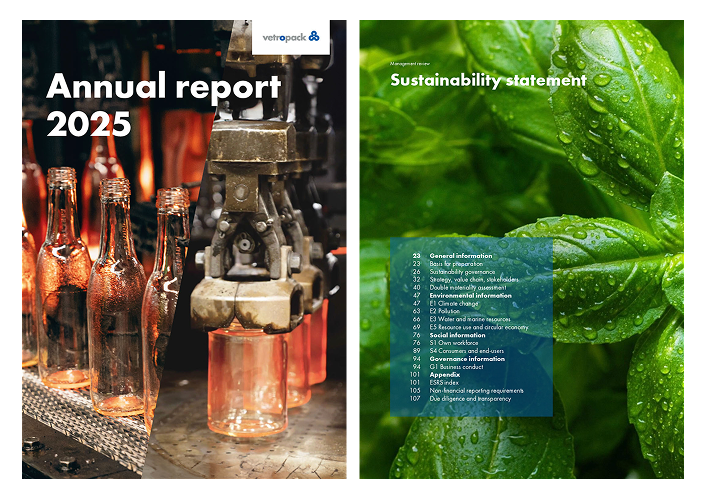
- Reporting concept: As part of the transition from the GRI Standards to the ESRS, Vetropack had to adapt the structure of its annual and sustainability report, and simultaneously used this transition as an opportunity to further improve the report’s readability and accessibility.
- Qualitative information collection: To collect the qualitative ESRS data points, Sustainserv translated the key data points into easy-to-understand questionnaires for Vetropack’s subject matter experts. Sustainserv also supported the subject matter experts through workshops and meetings to familiarize them with the reporting requirements, which helped ensure targeted preparation of the content. By broadly involving internal stakeholders, this process raised awareness of the importance of ESG reporting.
- Report development: Based on the information gathered and taking into account input from the subject matter experts, Sustainserv developed the report content, which addressed the key ESRS requirements and data points. As part of the text development process, Sustainserv also supported Vetropack in the conceptual design of layout elements, such as the value chain and the overview table on stakeholder management.
- Finalization: As in previous years, Sustainserv transferred the content into the publishing system and implemented the final adjustments directly within the system in close collaboration with Vetropack.
Results
The in-depth examination of the new reporting requirements helped Vetropack identify gaps in data points, reporting processes, and strategic elements such as goals, guidelines, and responsibilities. The transition to ESRS thus formed an important foundation for the further development of sustainability management.
To prepare for the mandatory external audit starting with the 2027 reporting year, Vetropack involved the auditor at an early stage and sought specific feedback on the implementation of selected data points as well as on internal processes and control mechanisms. Although no limited assurance engagement has yet been conducted, Vetropack was pleased with the auditor’s final assessment: Overall, Vetropack’s qualitative and quantitative disclosures meet the requirements of the ESRS, conveying information in a pragmatic and clear manner. By voluntarily transitioning its ESG reporting to ESRS, Vetropack laid important groundwork for the future implementation of CSRD and associated audit requirements.
Immediately following publication, Vetropack developed an action plan to address identified gaps and improve reporting in the future.
As part of its work on sustainability reporting for the 2025 fiscal year, Vetropack was also able to improve its EcoVadis rating from Bronze to Gold.
The voluntary and early transition to ESRS provided Vetropack with valuable practical experience and laid a solid foundation for the future implementation of CSRD requirements and the associated audit obligations.
Get in touch. We are happy to tell you more about it.