The challenge: from informal to formal ESG approach with limited resources
Basilea Pharmaceutica has always placed a high value on responsible, forward-looking management. Given the size of the company in its early years, informal management of environmental, social and governance (ESG) topics was initially sufficient. As the company, and expectations from stakeholders, grew, it was deemed necessary to transition to a more formal, robust and transparent program of ESG strategy, management and disclosure. The question was how to best do this in a manner that enhanced but did not distract from the company’s core business activities with team members that were already multi-tasking and could hardly be expected to keep all balls in the air for such a new program without very structured support.
About Basilea
Basilea is a commercial-stage biopharmaceutical company founded in 2000 and headquartered in Switzerland. Basilea has about 190 employees. We are committed to discovering, developing and commercializing innovative drugs to meet the needs of patients with severe bacterial and fungal infections. We have successfully launched two hospital brands, Cresemba® for the treatment of invasive fungal infections and Zevtera® for the treatment of bacterial infections. In addition, we have preclinical and clinical anti-infective assets in our portfolio. Basilea is listed on the SIX Swiss Exchange.
The goal: a robust ESG program supported and enhanced by AI
Basilea’s goal was to develop a robust ESG program that inspired its team members and made their participation manageable. A state-of-the-art ESG ambition statement that could be further developed into a rolling strategy document, governance with clear roles and responsibilities on ESG topics and a structured sustainability report that informed stakeholders such as investors and customers about the company’s ambitions and achievements were to be developed rather quickly. All this was to be supported by a structured platform for coordinating ESG topics, data points and ownership across the company, with AI workflows accelerating the more repetitive parts of report production.
Our approach
Establishing a structured, robust ESG program in a company needs a holistic approach with a series of elements that support each other. While the ‘textbook approach’ would be to first define ESG governance and strategy, then drive improvement programs against the defined strategic goals and finally measure and report the results, reality is usually more complex, and this “plan-do-check-act” cycle allows multiple entry points depending on where the company is at the moment.
Basilea chose to work with Sustainserv first on a materiality assessment to determine which ESG topics are related to its major impacts, risks and opportunities, and then to set qualitative ambition levels for these material topics. This was consolidated into an initial ESG strategy document that, as a side benefit, was also released as an online brochure to inform stakeholders.
Based on this strategic foundation, the Basilea annual report was enriched in the first cycle by an informal sustainability section. In the second year, this report section was developed in accordance with the GRI Standards using the AI-enabled sustainability reporting platform Palau to support Basilea in navigating sustainability reporting standard requirements in a structured and efficient manner.
During the development of this first GRI report, the roles and responsibilities of team members concerning different aspects related to Basilea’s material topics were captured in the Palau platform. These ESG-related roles had developed over time based on the specific capabilities of current Basilea team members. In the next step, Basilea is working with Sustainserv on formalizing and articulating this as a more explicit ESG governance structure that optimizes the assignment of responsibilities to functional roles throughout the organization to fit well with the overall tasks of the functions concerned, and thus would be meaningful and robust to continue as team members rotate into and out of specific organizational roles over time.
Learnings on dos and don’ts of AI-enablement
Throughout this process, AI has been seen to offer potential for more efficient workflows and more effective results
- Great for IROs, less so for ranking and evaluation
The materiality assessment, and the determination and consolidation of ambitions for the material topics into an initial ESG strategy statement, were mostly conducted before sophisticated AI tools became widely available. If this were done now, we see particular potential for identification and articulation of impacts, risks and opportunities (IROs), for which Sustainserv now has developed an AI-enabled tool, and for benchmarking on IRO prioritization among peer companies.
Conversely, we would counsel caution in letting AI rank and evaluate material topics and taking such AI generated materiality designations at face value. Prioritizing what is important or material for a company and its business environment is a strategy and business decision that needs human judgement, while it can become significantly more effective with context analyses and benchmark overviews produced by AI. - A structured AI tool is necessary
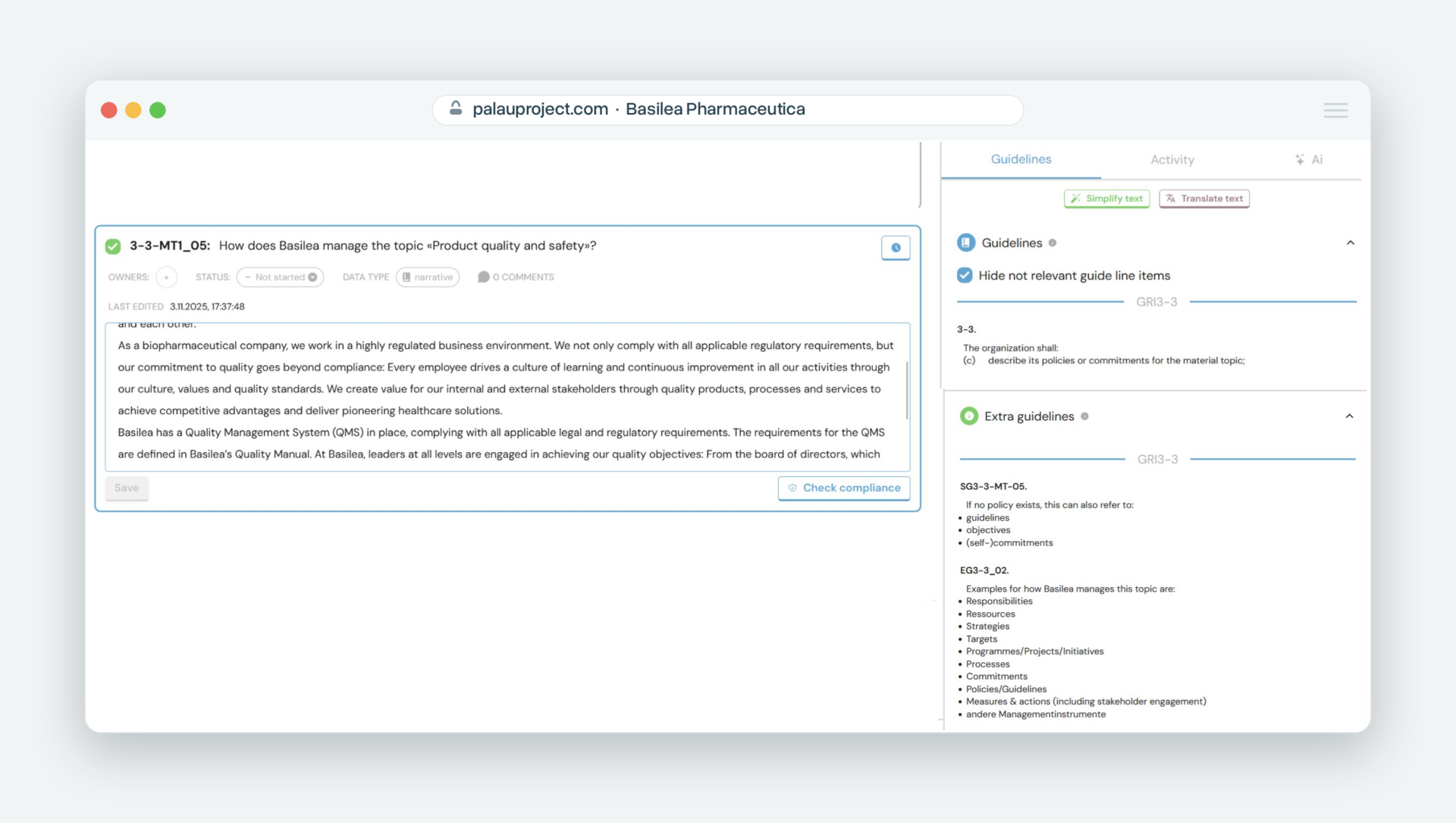
To produce the first GRI-compliant sustainability section in the Basilea annual report, the Palau sustainability reporting platform was used. This reporting environment had originally been developed for ESRS reporting, but in a Palau-Sustainserv collaboration was optimized also for GRI report development. One simple but effective benefit of using such a structured environment rather than free-floating AI application in report production is that the reporting standards are integrated and easily visible in a structured manner during content collection and development, supporting internal colleagues who were new to sustainability disclosure and busy with the ‘regular’ annual report work at the same time in understanding what was expected from them.
In this AI-enhanced reporting environment, Sustainserv supported Basilea to assign already available information to the most applicable GRI indicators and keep an overview of the requirements covered and the gaps still to close in the current report or where needed in the next reporting cycle.
- Drafting with AI, but human quality control essential
Concerning text development, revisions and approvals, human quality control stays essential in such AI-workflows. While AI tools such as Palau can produce first text drafts of individual disclosures or even report chapters, a report that is fully or mostly written by AI will, to a certain extent, sound generic and be reminiscent of other reports in the market. This can be improved by repeated reprompting and revisions, adjusting the balance and the tonality of the information given. However, in addition to the quality control aspect where human reviews are critical, multiple reprompting of AI text generation can be similarly time intensive to traditional text drafting.
Learnings included that instruction sessions can support and empower colleagues participating in the report development, especially in the first year. It helps to make crystal clear to them how their inputs are used and processed in an AI-enhanced environment, and how they should approach checks and approvals. - Don’t optimize the report at the cost of the reporting
One aspect of sustainability reporting that can get forgotten in the emphasis on technology and AI is that the final report document is not the only, and sometimes not even the main, valuable result of the sustainability reporting process. At least equally valuable is that collaboration on planning, drafting and refining the report gives colleagues throughout the company the opportunity to be exposed to, and to dive deeper into, the ESG aspects important to the company and its partners.
A good reporting process changes the minds (and sometimes also the hearts) of those involved. This is crucial to enable better, more forward-looking decisions to be made throughout the organization. If the whole report is developed by AI with colleagues just feeding in scattered bits of information, it becomes a pure box-ticking or compliance exercise, without real impact on the company and its long-term-focused steering. By keeping humans not just in the loop but ultimately in charge, the efficiencies of AI can be fully reaped while also retaining, and even enhancing, the change management benefits of reporting. - Gap analysis made easy
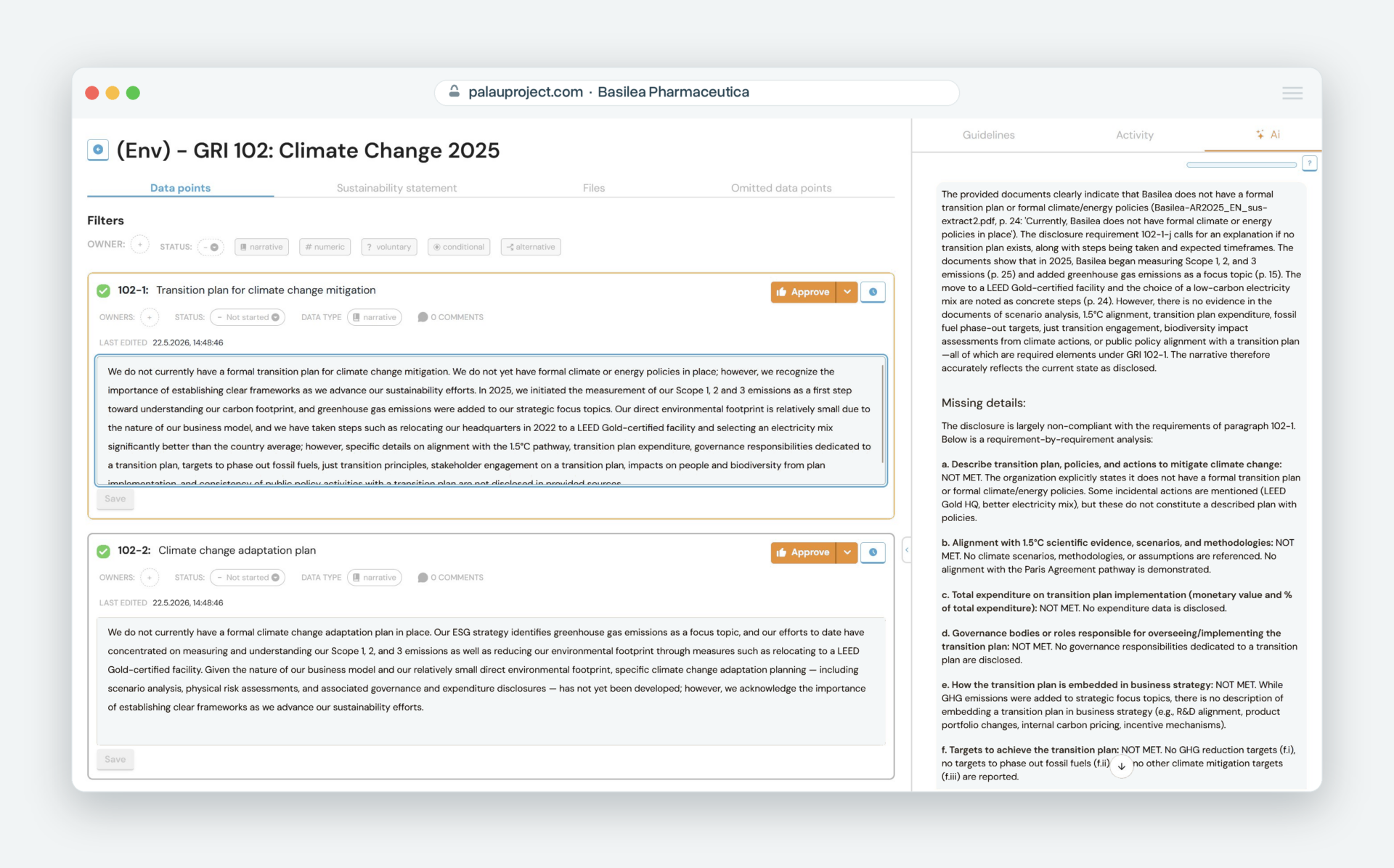
The reporting project was concluded with an AI-enabled gap analysis against the new standards GRI 102 and 103 for Energy and Climate reporting that are mandatory for GRI reports published in the subsequent year. This early preparation will save time in the next reporting cycle and is one of the examples of how report production in a structured, AI-enabled platform such as Palau can enhance efficiency and effectiveness over time. The same is applicable in cases where gap analyses against the latest version of ESRS and ISSB standards will become more important for companies over time.
- Governance determination grounded in status overview
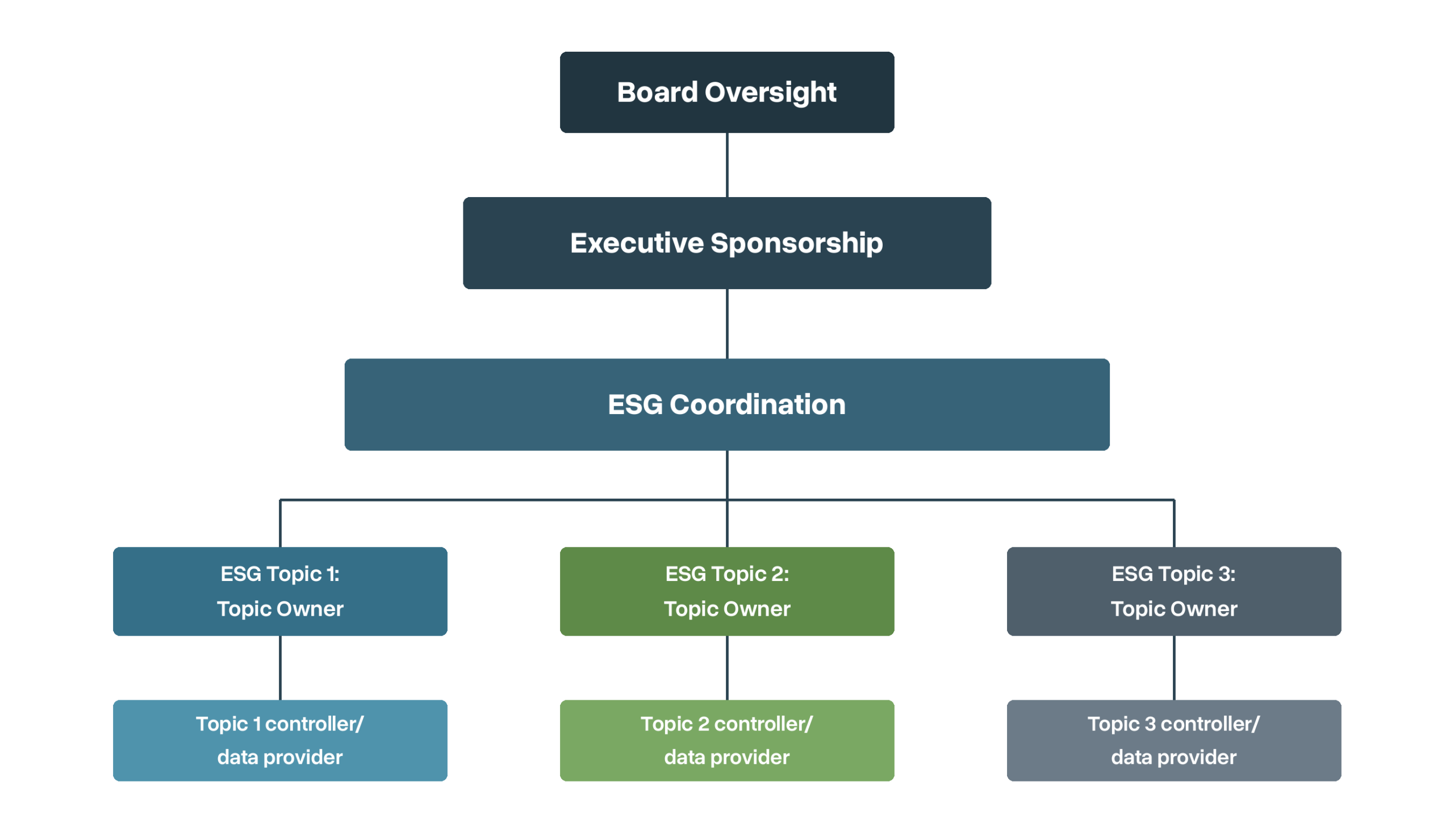
In addition to providing easy access to the standard requirements, the platform supports defining clear ownership for each topic and data point. In setting this up, some gaps and unclarities concerning sustainability governance were identified.
These gaps are currently being closed, with determining full clarity on roles and responsibilities. In this process, AI can particularly help with benchmarking how ESG roles are defined and work together in peer companies. Again, this should not be taken as an ultimate result but rather as inspiration for how the company in question would define these roles so that they fit its business model and environment.
Results
The structured, multi-year process at Basilea delivered a clear list of ESG topics material to the company, a strategic direction, concrete KPIs and goals for achieving progress over time, explicit internal role and responsibility designations for ESG aspects throughout the company, and transparent external sustainability reporting to keep investors, customers, and other stakeholders informed and engaged on Basilea’s sustainability journey.
Through the use of AI-enabled processes for content collection and report development, future adaptations to evolving reporting requirements, such as the new GRI topical standards on energy and climate (and, if needed, ESRS or ISSB reporting in the future), can be implemented in an easier and more robust manner than would be possible with a more traditional manual approach.
At the same time, keeping humans in the loop and in charge throughout ensures not only quality control but allows Basilea to reap the benefits of sustainability reporting that go beyond simply producing a document – that is, the reporting process engages the team on sustainability issues and creates alignment and inspiration throughout the company, driving progress over time.
View the Basilea Pharmaceutica Annual Report 2025 here.
Get in touch. We are happy to tell you more about it.