Sustainability reporting and management systems have forced companies to build something far more powerful than a compliance framework: they have created data systems, control mechanisms and governance structures that cut deep into the core of how their business operates. What is often seen as a regulatory burden is, in reality, an opportunity for a new kind of strategic capability.
The infrastructure that companies have created to facilitate climate reporting are scalable systems that can be leveraged to design credible transition plans, steer capital allocation and integrate adjacent sustainability topics into core decision-making. Through this lens, climate is not just another reporting requirement – it is the entry point to a new level of corporate maturity and value creation that embeds climate relevance into strategy to drive transformative, resilient business models.
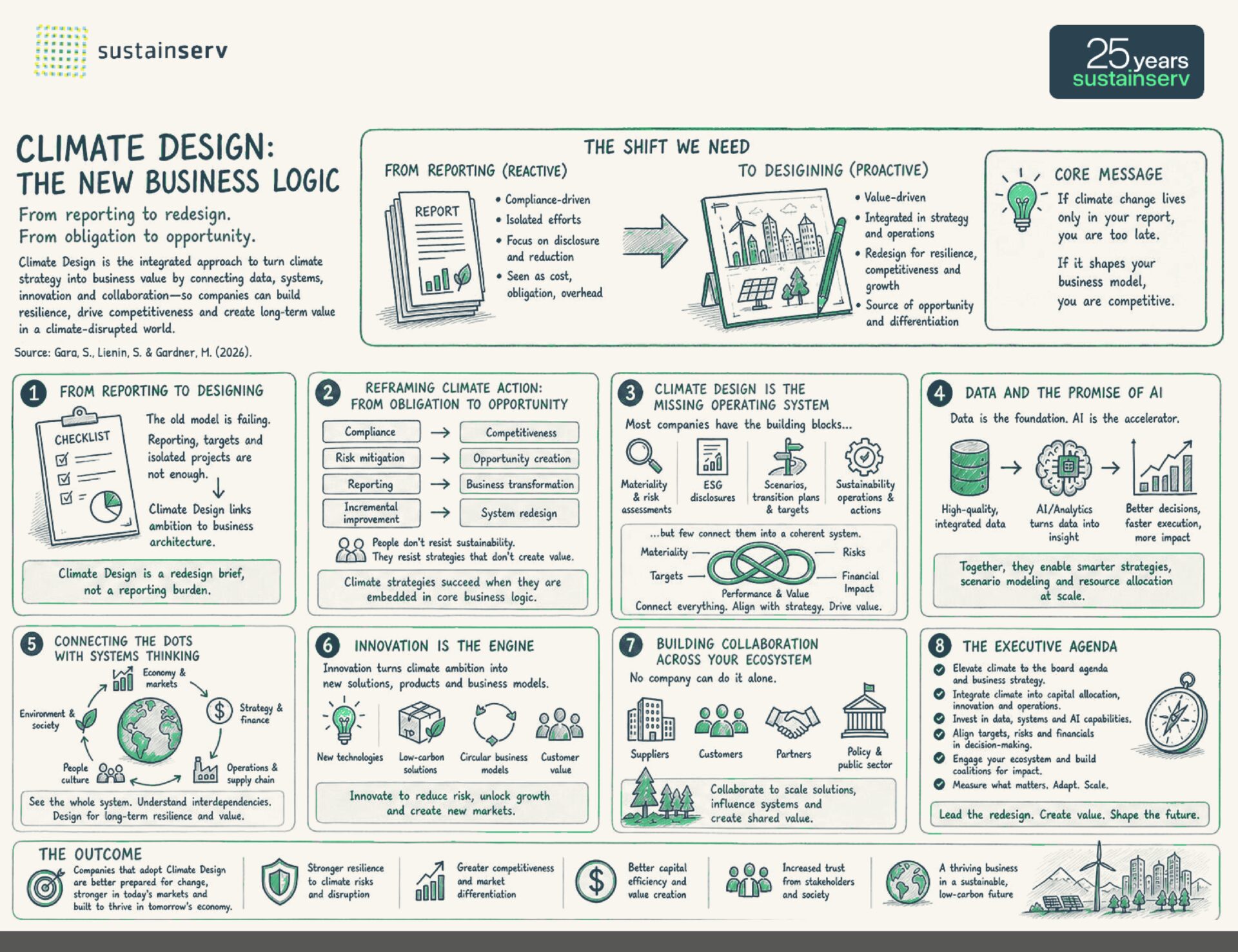
Sustainserv’s Climate Design approach starts exactly here, reframing this shift from reactive reporting to proactively designing for resilience, competitiveness and long-term value in a climate-disrupted world.
1. From Reporting to Designing
Reporting builds transparency. Design creates value.
For years, many companies treated ESG efforts as an externally driven obligation and resulting climate strategy as a separate roadmap owned by sustainability teams. As we witness the direct and dramatic impact that climate change is having on our economy and society, that model is breaking down. Climate risks and opportunities are now financial, operational and strategic topics that companies must consider across their operations.
As we speak, climate change is reshaping markets, supply chains, capital flows and customer expectations. Companies that still treat it as simply a compliance and reporting exercise are structurally misaligned with reality. Climate Design is the response to that misalignment.
Climate Design reframes the question from “How do we disclose and reduce our impacts?” to “How do we redesign the company so addressing climate change builds resilience, differentiation and value creation?”
Why the old model is failing
The old way of thinking was that climate action could be managed through targets, reports and isolated projects. Next-generation corporate climate leadership is increasingly about credible assessment and delivery: transition plans, implementation discipline and repeated scrutiny of whether the strategy is actually working in the real world.
This is why climate strategy fatigue is so common. Teams are asked to do more disclosure, more target-setting and more reporting, while the underlying business model and operating system often remain unchanged. Climate Design cuts through that fatigue by linking ambition to business architecture: investments, technology choices, governance, procurement and resilience planning. Climate Design is a redesign brief, not a reporting burden.
Takeaway: If climate change lives only in your report, you are falling behind. If it shapes your business model, you are competitive.
2. From Obligation to Opportunity
Climate strategy becomes effective when it is economically meaningful.
In many organizations, climate initiatives are still framed as cost drivers, compliance obligations or reputational safeguards. Not because climate action lacks urgency, but because it lacks integration.
That is not a sustainability failure; it is a strategy failure. Climate reporting may be more structured than ever before, but if it remains detached from capital allocation, operations and innovation, it will be seen simply as overhead.
Climate Design changes the narrative:
- Compliance becomes competitiveness
- Risk mitigation becomes opportunity creation
- Incremental improvement becomes system redesign
- Reporting becomes a blueprint for action
People do not resist sustainability. They resist strategies that do not create value.
Takeaway: Climate strategies succeed when they are embedded in core business logic.
3. Climate Design Is the Missing Operating System
Climate strategy becomes powerful when it becomes systemic.
Most organizations today already have the building blocks they need:
- Double materiality and risk assessments
- ESG disclosures
- Climate scenarios, transition plans and targets
- Sustainability operations and actions
Materiality identifies what matters to the business and its stakeholders. Disclosures provide transparency into how the company is doing with respect to its material issues. Transition plans and scenarios offer a forward-looking perspective into where the business can (or should) go. And these efforts are made real through operational initiatives such as energy efficiency improvements and sustainable supply chain activities.
But what most companies lack is a coherent architecture that aligns their sustainability efforts with business performance and recognizes how these elements can support strategic differentiation, resilience and growth. Future-oriented organizations must fuse materiality, targets, risks and financial effects into one mindset rather than separate silos. With Climate Design, those siloed perspectives can be integrated into an overarching strategy of value creation.
Climate Design also allows us to ask a simple but uncomfortable question: what would your company look like if it were built today for a volatile, climate-constrained world? Get ready, because the answer to that question can change everything: how you source, how you invest, who you hire, how you design products, how you organize supply chains and how you measure performance. In some cases, entirely new business models may emerge.
At its core, Climate Design is an integrated approach that combines:
- Data, which forms the empirical foundation to better understand risks and opportunities
- Systems thinking that helps us understand interdependencies
- Innovation that guides the redesign of products and processes
- Ecosystem collaboration, which extends impacts beyond the firm
By layering these perspectives on top of the basic ESG toolkit that companies are increasingly deploying, we can shift the current reactive, compliance- and disclosure-driven mindset into one that is forward looking, risk-sensing, and business-centric.
4. Data and the Promise of AI
Advanced data and analytics decode risks and unlock opportunities.
Companies have increasingly deployed sophisticated systems to gather a wide range of ESG-relevant data from across their organizations. In some instances, these platforms allow for real-time or near real-time snapshots of how the company is performing with respect to energy and emissions, water, health and safety, as well as progress against goals.
Acquiring high-quality data and being able to quickly decipher trends and understand the empirical connections between disparate datasets are essential to planning for future scenarios. This is where the rapid advancement of artificial intelligence models can spawn transformation by providing new and extremely powerful tools for corporate decision making, and ultimately, Climate Design. It enables companies to gather the data from siloed repositories, quickly assess the quality of data, reconcile the data across different timeframes, data systems, and languages, and effectively and credibly model for missing data sets.
Takeaway: Climate Design is predicated on the availability of high-quality data that allows for AI-enabled analysis and modeling.
5. Connecting the Dots with Systems Thinking
Once the data is flowing, you will have a better understanding of the hidden interdependencies.
What’s missing in most cases is the empirical connections between different metrics and the forward-looking modeling capabilities that would inform decision-making. Climate Design is predicated on leadership teams being able to ask questions such as “If I optimize for the Scope 1 emissions at Facility X, what is the impact on water consumption?” or “What is the impact on my Scope 3 emissions if I replace a higher embedded carbon material with a less-carbon intensive material from a more remote supplier?” A core principle of Climate Design is that we can optimize our current performance (or model future performance scenarios) by asking these types of questions.
Ultimately, Climate Design provides a structured approach to:
- Scenario analysis for climate risks & opportunities
- Optimization of operations and energy use
- Faster and more adaptive decision making
- Improved supply chain transparency
Takeaway: Sustainability strategy is not about doing more. It is about choosing what matters most and understanding and accepting tradeoffs. This shifts the focus from optimizing individual performance metrics to designing integrated systems.
6. Innovation Is the Engine
You cannot decarbonize yesterday’s business model.
A Climate Design approach reconfigures the full value chain. Upstream, it means supplier decarbonization, material innovation and risk diversification. In core operations, it means energy optimization, circular processes and digital optimization. Downstream, it means product redesign, new business models and customer engagement.
But this will require a collaborative mindset that transcends traditional corporate silos and incentive systems. To design new products, new use cases, and new business models, companies will need to provide the infrastructure, and more importantly, the culture that will enable them to think in new ways. Clayton Christensen’s seminal work, The Innovators Dilemma, outlined how difficult this challenge is. But it also provided some key ideas for how to innovate in a rapidly developing space:
- Create independent teams or business units with their own P&L (profit & loss).
- Use discovery-driven planning (not traditional forecasting)
- Align incentives with the behavior you actually want
- Accept faster decision cycles and increase your tolerance for ambiguity
- Lastly, develop a culture of innovation “governance” not just ideas in a vacuum.
The most advanced companies will not only ask how to comply, but how to lead. Climate Design helps them create new demand, redefine customer expectations and set industry standards. That may mean designing low-carbon products that outperform alternatives, building ecosystems competitors cannot easily replicate, or turning sustainability into a brand and pricing advantage.
This is where corporate sustainability moves from defense to offense. Reporting proves accountability. Climate Design creates option space.
Takeaway: Climate leadership translates into market leadership. The companies that win will not just be greener; they will be smarter and faster.
7. Building Collaboration Across Your Ecosystem
Decarbonization happens across the value chain — not only within company boundaries.
For many companies, most greenhouse gas emissions occur beyond their own operations, across (and sometimes deep into) the value chain. Reducing Scope 3 emissions is therefore not about better disclosure; it requires coordinated action across that chain: supplier collaboration, customer engagement, industry alliances, product redesign and, in some cases, entirely new business models.
The strategic implication is clear: companies must move from measuring emissions to actively shaping the ecosystems they depend on. This means partnering with key suppliers, co-investing in low-carbon solutions and fundamentally redesigning sourcing, logistics and product systems.
Takeaway: Value chain transformation is a collaboration challenge, not a compliance or reporting exercise.
8. The Executive Agenda
Climate strategy becomes real when it is embedded in core decisions.
Climate Design positions climate change not only as a constraint, but as a design parameter for future business success. However, as is famously attributed to management guru Peter Drucker, “culture eats strategy for breakfast,” meaning organizational culture—shared values, behaviors, and norms—often overrides even the best strategies unless aligned. In Climate Design, fostering a culture of resilience, adaptability and climate awareness is essential to embed climate as a core principle.
Key priorities for leadership:
- Integrate climate into core strategy: Not as a parallel track, but as part of business planning
- Develop actionable transition plans: Link targets to investments and operations
- Strengthen data and analytical capabilities: Enable faster and more informed decisions
- Engage the value chain: Build partnerships beyond organizational boundaries
- Align incentives and governance: Ensure leadership accountability
Climate leadership will increasingly be judged not by ambition statements, but by whether a business can absorb shocks, reconfigure supply chains and deliver and create value in a climate-disrupted world. Without a supportive culture that rewards innovation, embraces failure as learning and prioritizes long-term resilience over short-term gains, strategic climate efforts will falter.
Climate Design gives C-suites a way to stop treating climate as a side hustle and start using it as a core design principle by aligning culture with operations. The companies that win will not be those with the longest reports, but those that redesign operations, partnerships, products and investment choices around resilience, adaptability and long-term value creation – supported by a culture that unfreezes old habits through training, agile mindsets, and updated incentives.
Climate Design is not about ticking boxes or optimizing at the edges. It is about reimagining the company as a system that creates value, withstands shocks and contributes to a climate-positive future.
ESG without strategy is noise. Strategy without Climate Design is risk.
Bottom line: Climate is not only a constraint; it is a design parameter.
Get in touch. We are happy to tell you more about it.